Can the Government of Canada Take Away Citizenship It Already Granted? What Is Happening Right Now with Bill C-3
What is happening this week in Canada is, without exaggeration, one of the most unsettling immigration events I have witnessed in my 26 years of professional practice.
Immigration, Refugees and Citizenship Canada is sending notifications to people who have already received their Canadian citizenship certificate, demanding that they return it while their files are placed under review. Not applicants still in process. People who already had their citizenship in hand.
It All Started on December 15, 2025: Bill C-3
To understand what is happening today, we need to go back to last December.
On December 15, 2025, the Government of Canada passed Bill C-3, legislation that amended the Canadian Citizenship Act and removed what was known as the “first-generation limit” in certain situations. Before this reform, a Canadian citizen could pass citizenship on to children born outside Canada, but only to the first generation born abroad. The children of that first generation that is, the second generation born outside Canada were excluded, even if they had a genuine connection to the country.
This reform came as a direct response to a judicial ruling: on December 19, 2023, the Ontario Superior Court of Justice declared that the key provisions of the first-generation limit were unconstitutional, as they produced unfair outcomes for children of Canadians born outside the country.
The effect of Bill C-3 was immediate and far-reaching. The law was retroactive and automatic: anyone who would have been a citizen had it not been for that limit was recognized as a citizen from birth.
The Problem: Thousands of People Claimed What the Law Said Was Rightfully Theirs. And the System Was Not Ready.
It was predictable. When a door that wide opens, people walk through it. Between December 2025 and March 2026, 13,310 applications were approved under Bill C-3.
As of June 10, 2026, IRCC’s own data shows that 82,000 people are currently waiting for their citizenship certificate applications to be processed.
What no one anticipated or at least no one communicated publicly is that some of those approved applications contained, according to IRCC, insufficient documentation to support the claimed right. And instead of resolving that during the review process, many certificates were issued regardless.
What Happened the Weekend of June 13, 2026
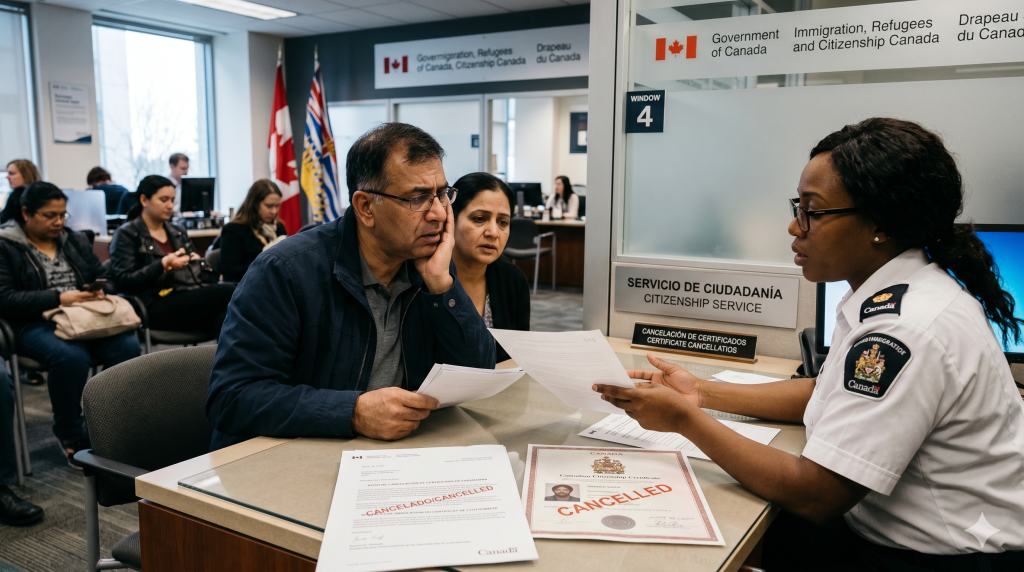
On June 15, 2026, IRCC sent emails to individuals who had already received their citizenship-by-descent certificates under Bill C-3, instructing them to surrender their certificates while their files were placed under review. The notice was signed by the Registrar of Canadian Citizenship, Peggy Sun, and affected approximately 4,075 people nearly half of them born in the United States.
IRCC confirmed to international media that it is “aware that a limited number of people who obtained a citizenship certificate under C-3 have been notified that their file is under review,” adding that the purpose is to “determine, through an individualized process, whether the certificate was properly issued based on the evidence required by law.”
Translated into plain language: the government approved applications, issued official citizenship certificates, and is now saying that some of those approvals may have been a mistake and it wants the certificates back while it figures that out.
Can IRCC Legally Do This?
This is the question everyone is asking this week, and rightfully so.
A critical technical distinction must be made: a formal revocation of citizenship under subsection 10(1) of the Citizenship Act is a separate legal process that applies when citizenship was obtained through fraud, false representation, or the deliberate concealment of material circumstances. The current notices do not allege fraud. They allege that the documentation submitted did not meet IRCC’s evidentiary standards — which is a different category of concern entirely.
What Concerns Me as a Professional and What Should Concern You
Beyond the legal technicalities, there is something no official IRCC statement will address honestly: the problem did not start with the applicants. It started with a system that approved documentation that, by its own standards, was not sufficient.
Behind each of those 4,075 certificates is a real person. A family that reorganized their life around that document. That made employment, educational, and immigration decisions based on an official approval from the Government of Canada. And now that foundation is being questioned not because of fraud, but because of a systemic failure in the review process that IRCC itself should have caught before issuing the certificate.
That is not a minor administrative error. It is a systemic failure with real human consequences.
The growing use of artificial intelligence and automated processing within IRCC’s systems has increased the speed of decisions, but not necessarily their accuracy or fairness. An approval generated by an automated system that is later manually reversed is not simply a bureaucratic correction it is a contradiction that calls into question the reliability of the entire process.
What You Should Do If You or Someone You Know Received One of These Notices
First: do not surrender any document without legal counsel. You have the right to an individualized process and to submit additional evidence before any final decision is made.
Second: the fact that your file is “under review” does not mean your citizenship has been revoked. Your application is being re-examined, not cancelled. You will have the opportunity to submit additional documentary evidence, and if your entitlement is confirmed, your certificate will be returned.
Third: seek qualified legal representation immediately. This is not the time for improvised solutions or unauthorized consultants. The implications of a citizenship revocation are permanent and far-reaching.
I have built my career representing people who trust that the system will work as it should. And most of the time, when an application is well prepared with solid documentation and competent legal guidance it does.
But cases like this remind me that no immigration process should ever be taken lightly, and that proper preparation is not a luxury it is protection. A poorly supported document at the initial application stage can become, months or years later, the very argument the government uses to reverse what you believed was already settled.
The immigration future of a person and of their family cannot be left in the hands of an incomplete process. Neither can yours.